


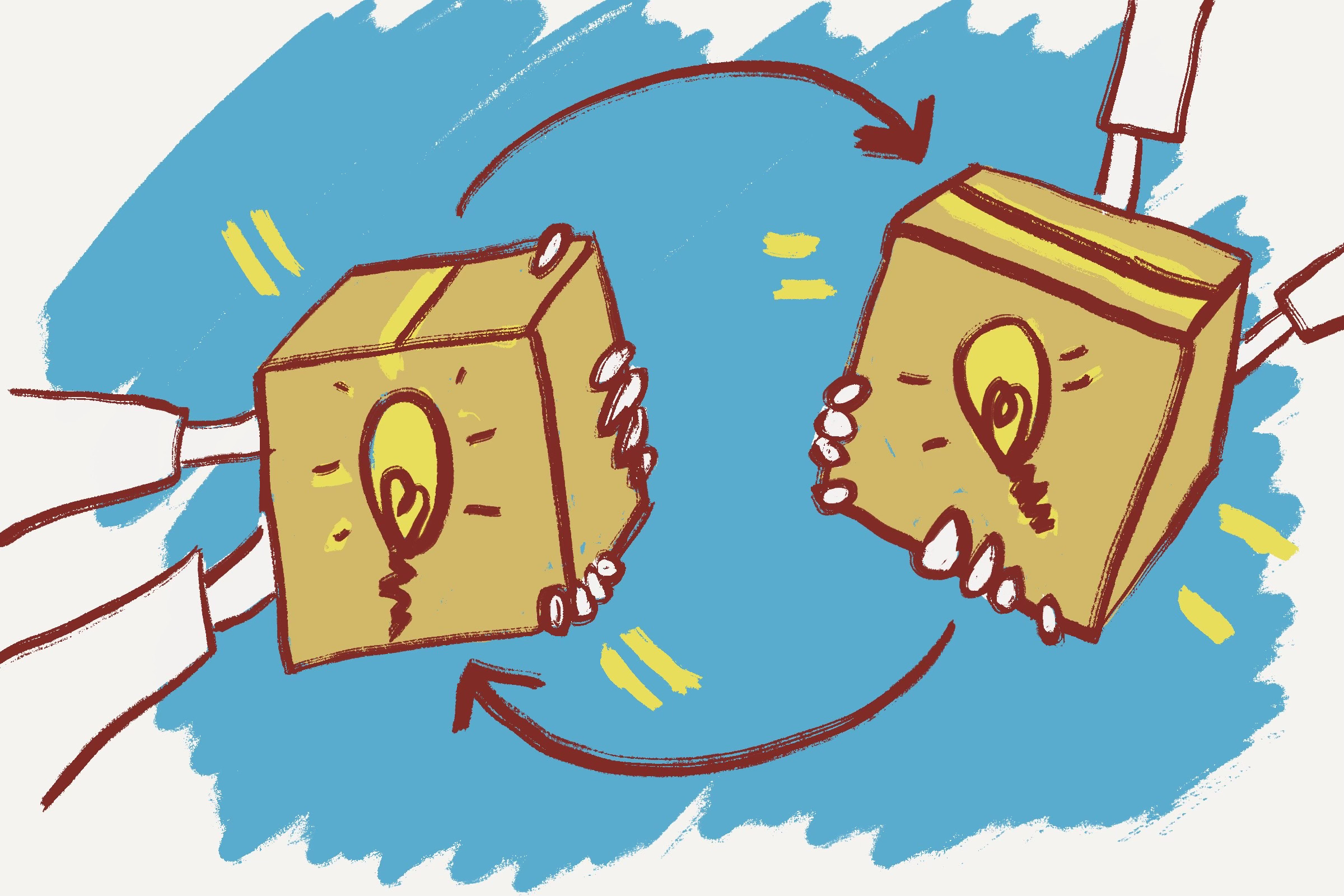
Let’s talk about the flow of reciprocity, and how it influences value capture.
Value, in the economic sense, does not always look like an obvious thing or pre-packaged parcel. Before it becomes something we can trade, it usually exists in the completely invisible realm. It’s very Ideas Economy to say this, but imagine that there are figments of thoughts, beliefs, or feelings in your body that have yet to form. This is what I’d call latent value. For latent value to become usable, it must then be developed enough to be something we can recognise, communicate, exchange, or build upon. Your thoughts in a particular area, for example, must be processed enough to then become a book, or a patent, or creative IP, or whatever it is. So, in this sense, value begins in the intangible realm before it can crystalise at all into something comprehensible, let alone economically understood.
This is important to grasp because, as we know it, our capitalistic systems are not equipped enough to capture the full breadth of human value. Maybe we will see that drastically change in the AI age. For now, capitalistic economies are optimised for two levers: leverage and scarcity.
This obviously works well enough to create some level of abundance in our world, but you can already see its shortcomings. Things that are immensely valuable for humanity, but cannot be measured easily, or ethically, against these two levers, are very difficult to remunerate effectively. (Think, medical research, public education, childcare, arts and culture, wildlife conservation, community services, and on.) There is a difference between something having value and our economic systems having an effective way to recognise and reward it.
If we are to investigate beneath these structures though, we find the underpinning mechanism through which value moves: reciprocity. We see it in business deals, personal relationships, philanthropic giving, and across life. It is the exchange of value between parties who each have something to contribute, but whose contributions need not be identical, immediate, or even monetary.
What makes this kind of exchange sustainable? Why does it sometimes expand the value available to everyone involved, while at other times it deteriorates into one-sided extraction? And what distinguishes a lasting reciprocal relationship from one that only captures short-term value?
Work with me on branding, partnership modelling & sponsorship design here.
Follow me on LinkedIn here.
