Do you subscribe to “removing the emotion” from your decision-making? Particularly if the stakes are high?
I disagree, and let’s talk about that.
While it’s often passed off as an innocuous phrase, “remove the emotion” is usually shorthand for something more reasonable: to not let irrational fear take the wheel. That, in itself, is sound. But it is reductive to proxy that with a suggestive that all emotion is therefore a distraction. Because the moment you do that, you make it significantly harder to listen to your intuition.
A strong gut feel, in business or in life, is undeniably a useful tool in decision-making. So, why would you deliberately reduce your access to it?
My sneaky suspicion is that, particularly in the West, we’ve overcorrected. A long, hard history of suspicion toward mystique and the intangible gave rise to scientific rigour, data-driven thinking, and systems of proof. All extraordinary things. But in the process, we’ve started privileging external markers of decision quality over our internal navigation systems. We trust (and economically back) what is measurable more than what is felt.
Have you ever experienced a key pivot moment in your life where nothing made logical sense, but you moved forward anyway — and it paid off? Perhaps you moved on from a career, accidentally met someone who led you to a dream relationship, or relocated on a whim with absolutely no clear rationale. And yet, those decisions become the most defining for you. This is your intuition speaking.
I suggest this not to entertain the esoteric, but to acknowledge the in-built, subconscious pattern recognition system already within you. Malcolm Gladwell’s Blink explores this notion at length. Those seemingly illogical gut responses are usually the result of accumulated information taken in beneath our conscious awareness, and surfacing as instinct before logic can catch up. It is thinking without thinking, to paraphrase Gladwell, and your emotions are its vessels.
Are we seeing now the threads between this aversion to emotion and society’s broader inability to name and quantify intangible value?
In my consulting work, I speak regularly with leaders of cultural institutions and non-profits who are trying to economically harness immense human value, yet operate within cash-strapped business models because that value is difficult to measure. This isn’t a coincidence.
The same instinct that tells us to “remove emotion” from decision-making is the one that struggles to account for value it cannot easily quantify.
To “remove emotion” may once have been useful advice. Now, it feels like wisdom that has hollowed out. It assumes humans are more erratic that they are — and in doing so, encourages us to distrust one of our most sophisticated internal systems.
On the contrary, removing emotion actually degrades decision-making.
Herein is the problem: emotion is being framed as noise, when it’s actually data you need to listen do.
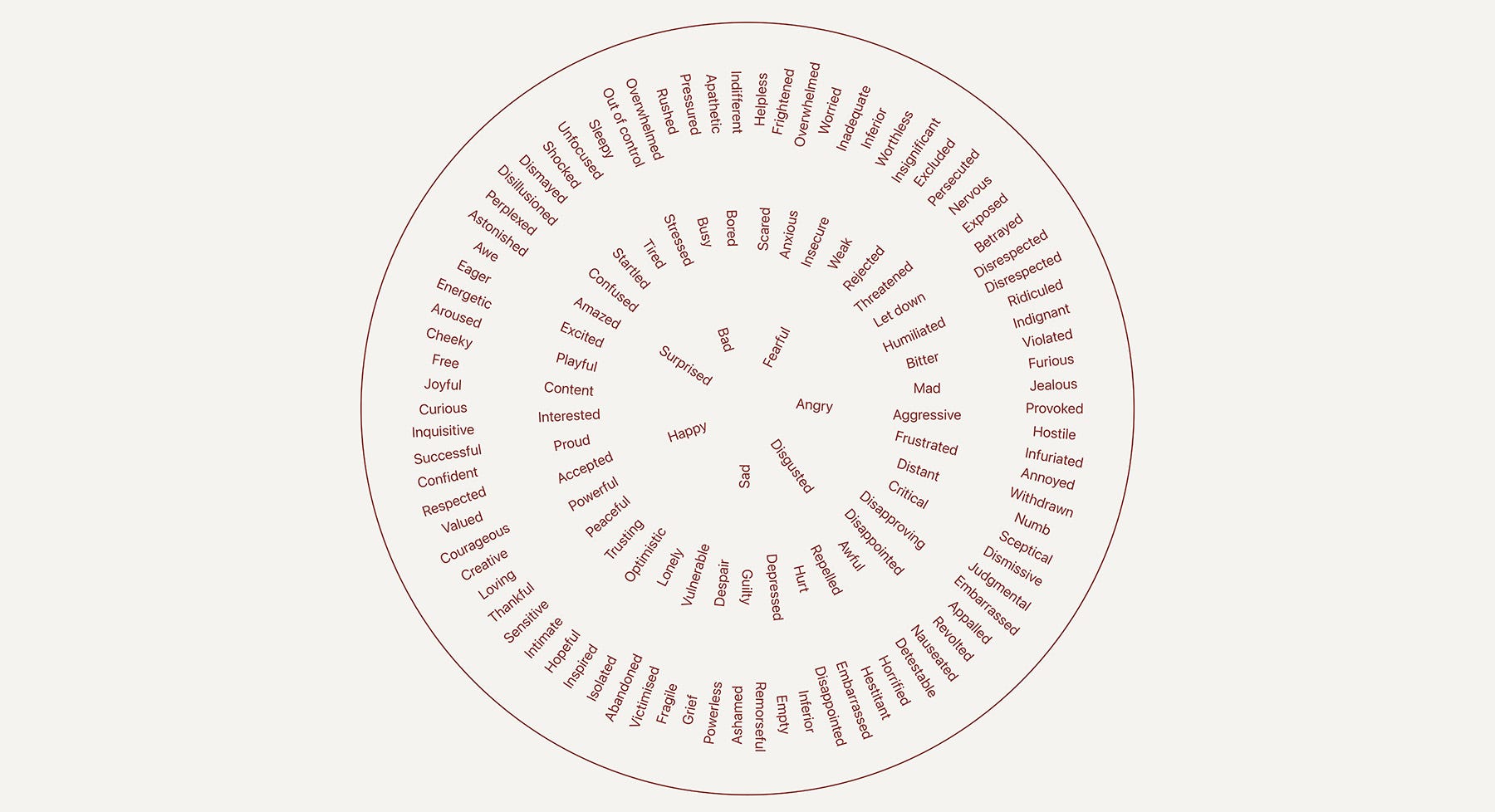
When you collapse emotion, reactivity, bias, and fear into one messy category, that in itself is a distortion. Think of the entire spectrum of human emotional experience. The Emotions Wheel is something you might have seen in a leadership course, or a therapy room. Do we really want to flatten all of that intel when making decisions? Or are we simply avoiding the work of understanding it?