


MENTAL MODELS are your monthly pocket-sized blueprints for structured intelligence. Synthesised frameworks derived from current data, research, and cultural trends, and precisely curated to be easily applicable tools as you work and create.
Creativity is abundant. Commercially complete ideas, however, are rare. Ideas typically die when the infrastructure to scale or monetise them is weak. While a moment of inspiration must be captured and celebrated, strong architecture is still required for good ideas to survive in market.
Ideas die when they lack:
Containers — a designed habitat for the idea to live.
Repeatability — a means of replicating an offer without the founder’s oxygen.
Translation — a bridge between the original imagination and market adoption.
Value design — an economical engine that protects the idea’s essence.
Across my work, I see a trending disconnect: some people breathe ideas (”creatives”), others breathe infrastructure (”operators”). Both are brilliant. Neither thrives alone.
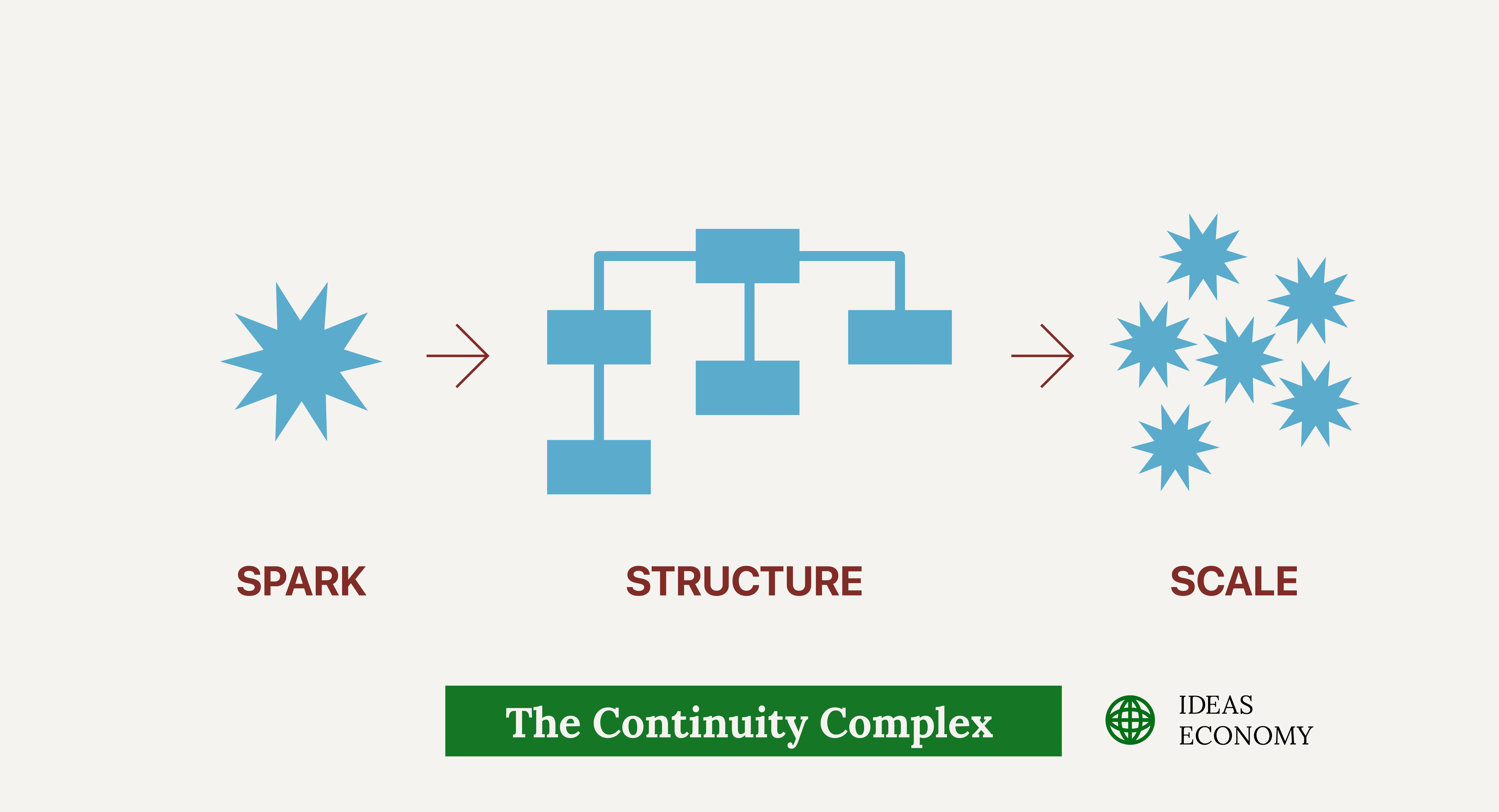
The Continuity Complex solves for this gap. A three-point reminder of how you might consider evolving your ideas after the moment of inspiration.
This month’s Mental Model:
The Continuity Complex
Key idea: Ideas earn longevity when their creative integrity and commercial viability grow together, not in opposition.
Use it to: identify the scaffolding your idea needs to endure.
Core components:
SPARK: harness the idea’s truth. What cultural tension does this idea resolve? Clarify the non-negotiable essence. The part of your idea that must not be compromised or diluted for convenience. If the spark is not protected early, the structure will distort it.
STRUCTURE: build the idea’s habitat. How does the idea function as a repeatable system? Define the container that enables the idea to operate and scale. Codify formats, rituals, IP, and the team required to deliver consistently.
SCALE: design the value accumulation. Where does energy (money, attention, reputation) pool and reinvest? Build permanence around your idea. This might look like distribution pathways, network effects, commercial engines. Whatever is necessary for the idea to be renewable.
Example: a live music experience turned commercially-repeatable model.
A music artist develops a distinctive live show. It has a unique production quality and setup, immersive audience energy, and a clear aesthetic. Artistically, it’s exceptional.
Here’s how the Continuity Complex stimulates the considerations for this to become a repeatable model:
SPARK: protect the creative soul of the project.
The artist dissects the show’s essential elements, and includes the emotional charge, sensory design, signature moments. The conceptual DNA of the work.STRUCTURE: give the art an operational backbone.
To evolve beyond one great show to a sustainable performance vehicle, they then map out:The production demands, both technical and creative.
The support team, so that the show is not operated by one person.
Venue or touring partners aligned with the concept.
A revenue model (tickets, merch, content capture, partnerships).
SCALE: extend the lifespan of the idea.
Next, the artist defines:What is ownable — IP elements of the show such as formats, audience lists, rituals, production design.
Style guides and technical assets — for consistent delivery.
Expansion pathways — across residencies, festivals, venues, cultural collaborators.
Audience pathways — for them to remain invested in their artistic journey.
A one-time performance now becomes:
A recognisable live experience format.
A creative identity that travels.
A lean commercial engine.
A cultural asset with compounding momentum.
Continuity is how creativity survives success.
If your ideas deserve more than applause, if they deserve architecture, let’s design the infrastructure they need to endure.
Brand and Cultural Strategy
Partnerships and Commercial Model Design